

Aircraft that watch a border must land to refuel, and troops dropped into the Himalayas face thin air that makes parachutes violent. On 6 October one DRDO lab reported answers to both: an airship that climbed to 21 km, and the first live jump with a new high altitude parachute.
By the AllIndia.news defence desk. Published . Written from 6 sources, 3 of them official, listed at the end.
The problem: watching for long, from high up
Watching a wide area for a long time is hard. An aircraft can circle only until its fuel runs low, and then it has to land.
An airship floats because it is lighter than air, so it does not burn fuel just to stay up. Park one in the stratosphere, roughly twice as high as airliners fly, and in principle it could watch a wide area for a very long time.1
That is the goal of DRDO's High-Altitude Platform. In 2025 the Defence Minister said such an airship would improve India's earth observation and surveillance, and put India among the few countries with such indigenous systems.3
The first try: 17 km
On 3 May 2025 DRDO flew its first stratospheric airship from Sheopur in Madhya Pradesh. It reached about 17 km, in a flight of about 62 minutes, testing how the envelope holds its pressure and how it can be deflated in an emergency.34
6 October: 21 km
Seventeen months later the ministry reported the next step. The airship climbed to 21 km above sea level and held at 20 km for more than 30 minutes before it was brought down, recovered and its data analysed.1
Live video and data streamed to the ground throughout. On board were motion sensors, a GPS receiver, cameras and an altitude control system. The flight needed the Air Force, airworthiness and aviation regulators and the Airports Authority to work together.1
But half an hour is not long endurance
The minister called the flight an important milestone towards a long endurance stratospheric airship. That wording is honest. The aim is a platform that stays up for very long periods. Half an hour at altitude has not shown that yet.1
The other end of the sky: a jump over Ladakh
The second release, from the same lab, the Aerial Delivery Research and Development Establishment in Agra, was about getting soldiers down rather than eyes up.12
At high altitude the air is thin. The ministry says static line jumps there are complex and inherently risky because of the very high opening shock and speed of descent. A static line is a cord tied to the aircraft that pulls the parachute open automatically.2
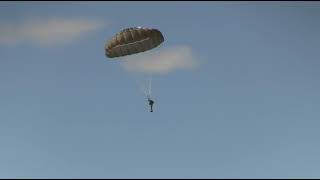
Over the Mudh drop zone at Nyoma in Ladakh, the first live jump with the Advanced High-Altitude Parachute was made at 16,000 feet. The canopy opened at 15,500 feet and the landing was at 13,700 feet. The system is rated up to 18,000 feet.2
It is an Indian supply chain from end to end: made by the Ordnance Parachute Factory in Kanpur, inspected by DGAQA and certified by CEMILAC's centre in Kanpur.2
What to watch next
For the airship, longer flights and real surveillance payloads. For the parachute, more live jumps and production orders. BusinessLine and The Week reported both trials from the ministry's figures.56
What to watch next
- Longer flights for the High-Altitude Platform, the real test of endurance.
- Payload trials with surveillance sensors on board.
- Production orders for the Advanced High-Altitude Parachute.
Watch on official channels
Sources
- DRDO conducts flight trial of High-Altitude Platform PIB, Ministry of Defence, official
- DRDO conducts maiden live jump of Advanced High-Altitude Parachute PIB, Ministry of Defence, official
- DRDO conducts maiden flight-trials of Stratospheric Airship Platform, 3 May 2025 PIB, Ministry of Defence, official
- India conducts maiden flight-trials of stratospheric airship platform The Hindu, news report, context only
- DRDO tests indigenously developed stratospheric surveillance platform HAPS The Hindu BusinessLine, news report, context only
- Two tests, two high-altitude milestones: what DRDO achieved in the skies The Week, news report, context only
Spotted an error? See the corrections policy.